
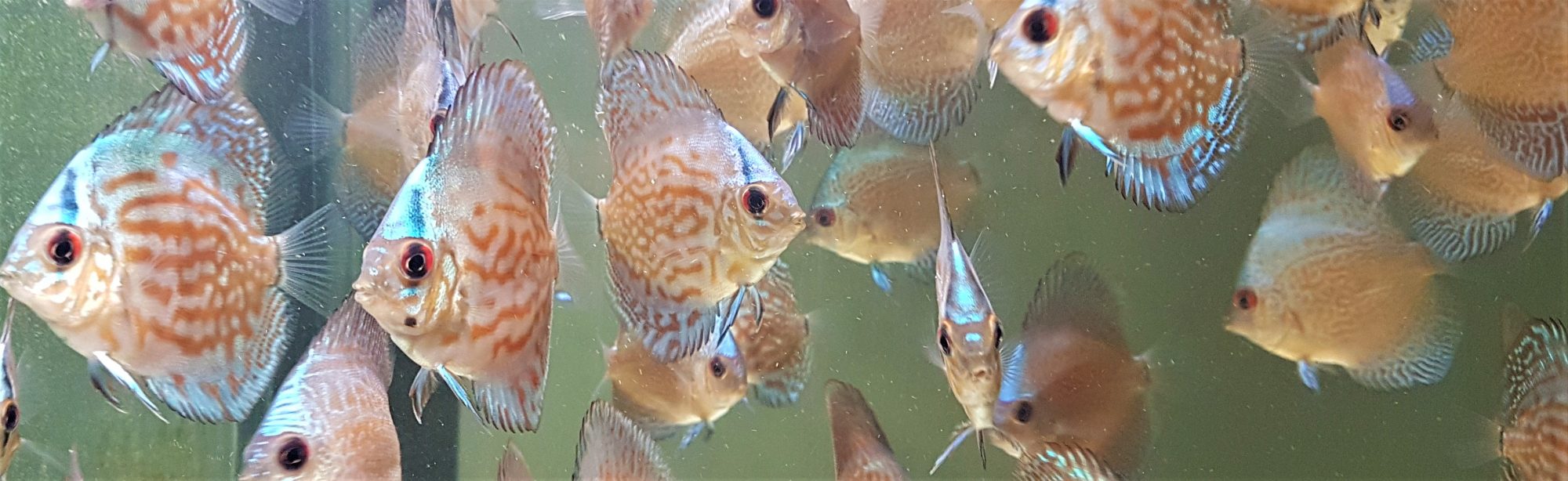
Aquarium enthusiasts are proud of their fish. We are especially fond of the most stunning and gorgeous specimens. There is something magical in observing the majestic beauty of a strong, dynamic fish displaying its energy, magnificent colors and strength. Naturally, we focus our attention on these most outstanding fish.
While keeping discus, this affection to the most spectacular fish may lead to problems because the most important discus in your tank is the smallest discus. The one bullied by other fish and often hiding in the corner.
Why is it so?
The answer to this question is hidden in the unseen structure of discus social interactions. Discus are hierarchical any every group of discus has a clear hierarchy of a more or less linear structure. The order becomes established very quickly after releasing fish in to the tank. Any new discus added to the existing group will need to adjust to the existing order. This usually takes a day or two, in some rare cases several days.
Depending on the new fish, it may become the dominant individual, be somewhere in the middle of the hierarchy, or end up at the very bottom of the established order. This means that if you have five discus, they will have a rank of the 1st fish, 2nd fish, 3rd fish, 4th fish and finally, the 5th fish.
The ‘last’ fish will be submissive to all others in the tank. It will yield to any other fish while feeding or competing for a mate. Being constantly under stress and not eating well, this fish will be quickly overgrown by other fish. With time, if not addressed by the aquarist, the smallest discus will suffer from malnutrition and, if its situation does not improve, will eventually die.
After its death, the next to that last fish in the established hierarchy will now take its place. It will be its turn to hide in the corner, or behind the driftwood, and allow others to feed while waiting for their turn. The cycle will repeat, and, again, if not addressed properly, the fish will be lost to either starvation or disease caused by malnutrition.
AS you can see, if the hobbyist is not able to ensure survival of the smallest discuss living in the lowest rank, in a matter of months only 2-3 discus will be left alive. If only 2 or 3 are left, they will be constantly stressed because discus prefer to stay in groups (if they are not breeding). Stressed fish will eat less and become weaker. A fish with a frail immune system will succumb to infections or parasites.
Therefore, if you want to have a group of healthy discus in your tank, you need to ensure the survival of the smallest discus. This can be achieved in many ways:
- Ensure the tank is big enough to allow weaker discus to have safe space without hiding.
- Keep at least eight discus in the tank. My observation is that in groups of discus consisting of eight or less fish, bullying of the weakest one is extreme. In groups of eight (and preferably more) the aggression is well dispersed and allows the weakest to find food and feel relatively save.
- While feeding, put the food in several places in the tank so the stronger fish are not able to prevent the smaller ones from feeding.
- Have all discus in the tank of similar size.
- Provide some structures in the tank (such as driftwood) that break the continuity of the tank and allow the smallest ones to swim freely without being constantly exposed to the aggression of stronger discus.
Following these steps should allow your smallest discus to do well. This will protect the established hierarchy in your tank and ensure the wellbeing of all your fish.